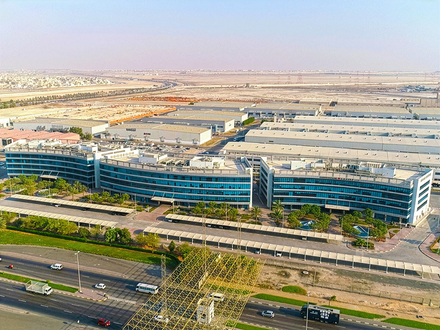
Musaffah occupies a distinctive position in Abu Dhabi’s commercial real estate landscape. The district has developed as a major industrial and business area, bringing together manufacturing facilities, warehouses, offices, service businesses, retail premises, and commercial land. Its character is closely connected with the needs of companies that require functional infrastructure, efficient transportation links, and suitable facilities for day-to-day operations.
Commercial real estate in Musaffah is primarily focused on practical business requirements. Unlike Abu Dhabi’s central business districts, the area has a strong concentration of properties designed for manufacturing, storage, distribution, trading, and industrial services.
Commercial property options in Musaffah
Warehouses represent one of the most important segments of the local commercial property market. The area includes standalone storage facilities as well as properties combining warehouse, office, and supporting spaces. This format can be particularly useful for businesses that need administrative functions close to their storage or operational facilities.
Musaffah also offers offices, commercial buildings, showrooms, service workshops, and industrial land. The variety of property types allows companies to consider different solutions according to their business activities, operational requirements, and space needs.
Industrial City Abu Dhabi (ICAD), located to the south of the Musaffah Industrial Area, is another important component of the local industrial market. It includes dedicated clusters supporting different industries, including manufacturing, engineering, construction materials, metal and steel, and oil and gas services.
Transport and logistics advantages
For industrial and logistics businesses, accessibility is one of the most important factors when evaluating commercial property. Musaffah has an established road network connecting its different sectors with other parts of Abu Dhabi. The Abu Dhabi–Al Ain Truck Road provides an important route for heavy transport, while Musaffah Port supports trade and logistics activities.
This infrastructure makes the district suitable for businesses involved in supply chains, warehousing, distribution, and the movement of heavy or bulky goods. When assessing a property, companies should therefore consider more than the available floor area. Truck access, loading and unloading arrangements, and the permitted use of the premises can be equally important.
What to consider when selecting a property
Choosing commercial real estate in Musaffah requires an assessment based on the company’s specific operating model. For warehouse users, factors such as ceiling height, electrical capacity, equipment requirements, loading access, and internal configuration can influence the suitability of a property.
Manufacturing companies should additionally verify whether the premises meet the requirements of their intended activity and whether the necessary approvals are available. For office users, layout, condition, parking, accessibility, and convenience for employees and visitors are among the practical considerations.
Investors may focus on the characteristics of the property itself, its position within Musaffah, potential tenant demand, and the long-term liquidity of the asset.
The role of Musaffah in Abu Dhabi’s commercial market
Musaffah continues to play an important role in Abu Dhabi’s industrial and commercial infrastructure. Its diverse property stock allows businesses to consider the area not only for existing operations but also for the expansion of manufacturing, logistics, distribution, and trading activities.
The key strength of Musaffah is its functionality. Commercial real estate here is closely connected with real business processes, making the district particularly relevant to companies requiring warehouse, industrial, office, or combined-use premises.
For businesses evaluating Abu Dhabi as a base for operational activities, Musaffah represents a commercial environment where location, transport accessibility, property functionality, and permitted use should be considered together when making a real estate decision.